Why the Tax Court Keeps Rejecting Estate Valuations
In an estate matter, the fight usually isn't about the law. It's about what the property was worth on the valuation date, and whether the appraisal behind that number holds up.
Two Tax Court cases show the two most common ways an estate valuation falls apart: the wrong person prepared it, or the data didn't fit the property. Either one can cost the estate the value argument, and sometimes its penalty defense too.
Key idea: The court doesn't have to pick either side's number. When neither valuation convinces the judge, the court can build its own, and that takes control away from your client.
The Standard Every Estate Appraisal Is Measured Against
For federal estate and gift tax, fair market value is defined in Treasury Regulation § 20.2031-1(b) as the price at which property would change hands between a willing buyer and a willing seller, neither under any compulsion to buy or sell, and both having reasonable knowledge of the relevant facts.
That definition is hypothetical on purpose. The appraiser isn't asking what a family member would pay or what a quick sale would bring. They're asking what the open market would have paid as of the valuation date, using only what was knowable then.
Case 1: Estate of Richmond, When Credentials Aren't Optional
In Estate of Richmond v. Commissioner, T.C. Memo 2014-26, the estate reported a 23.44% interest in a family investment company at $3,149,767, a figure the Tax Court found was too low.
The estate had relied on an unsigned draft report prepared by its accountant, who had some valuation experience but was not a certified appraiser. The court sustained a 20% substantial valuation understatement penalty and rejected the estate's reasonable-cause defense, finding that a valuation of that size and difficulty called for a certified appraiser (analysis of the opinion).
Richmond involved a business interest, not a house, but the lesson carries straight over to real estate:
✓ A draft is not a report. Get a final, signed appraisal.
✓ "Has done some valuation work" is not the same as a credentialed appraiser.
✓ Relying on an unqualified valuation can cost the estate its penalty defense, not just the value argument.
Why it matters: Under 26 U.S.C. § 6662(g) and (h), an estate or gift tax value reported at 65% or less of the correct value is a substantial understatement (20% penalty), and 40% or less is a gross misstatement (40% penalty). A qualified, well-supported appraisal is the estate's best reasonable-cause evidence.
Case 2: Ludwick v. Commissioner, When the Judge Rejects Both Appraisals
Ludwick v. Commissioner, T.C. Memo 2010-104 involved a Hawaii vacation home owned by spouses as tenants in common, with each half-interest transferred to a qualified personal residence trust.
The question was how much to discount each 50% interest:
Position | Discount on each half-interest |
|---|---|
Taxpayers' gift tax returns | 30% |
IRS (as allowed) | 15% |
Tax Court's result | About 17% |
According to published summaries of the opinion, the court was dissatisfied with both sides' appraisals and criticized how well their comparable data fit the property. Instead, it built its own discount around the cost and likelihood of a partition action, plus marketability risk.
Lesson for counsel: Comparable data has to fit the property and the interest being valued. When it doesn't, the court may set its own number, and neither client gets the result their expert promised.
What the Two Cases Have in Common
What the court trusted | What the court rejected |
|---|---|
Signed, final reports by credentialed appraisers | Unsigned drafts and uncredentialed preparers |
Comparables that fit the property and the interest valued | Data that didn't match the asset being valued |
Reasoning the court could follow and test | Conclusions that leaned on assumptions |
A value tied to the correct valuation date | Values the court had to rebuild itself |
What to Ask For in an Estate Appraisal
Before you engage an appraiser for an estate or probate matter, confirm:
✓ The right effective date. Date of death, or the alternate valuation date if the estate elects it. See our guide on which valuation date you need for an estate appraisal.
✓ A state-licensed or certified appraiser with relevant experience, preparing a signed, final, USPAP-compliant report.
✓ Comparable sales that were knowable as of the effective date, especially for a retrospective appraisal.
✓ The interest being valued spelled out. A whole house and a 50% tenant-in-common interest are different assignments.
✓ An appraiser willing and able to testify and explain their choices under cross-examination.
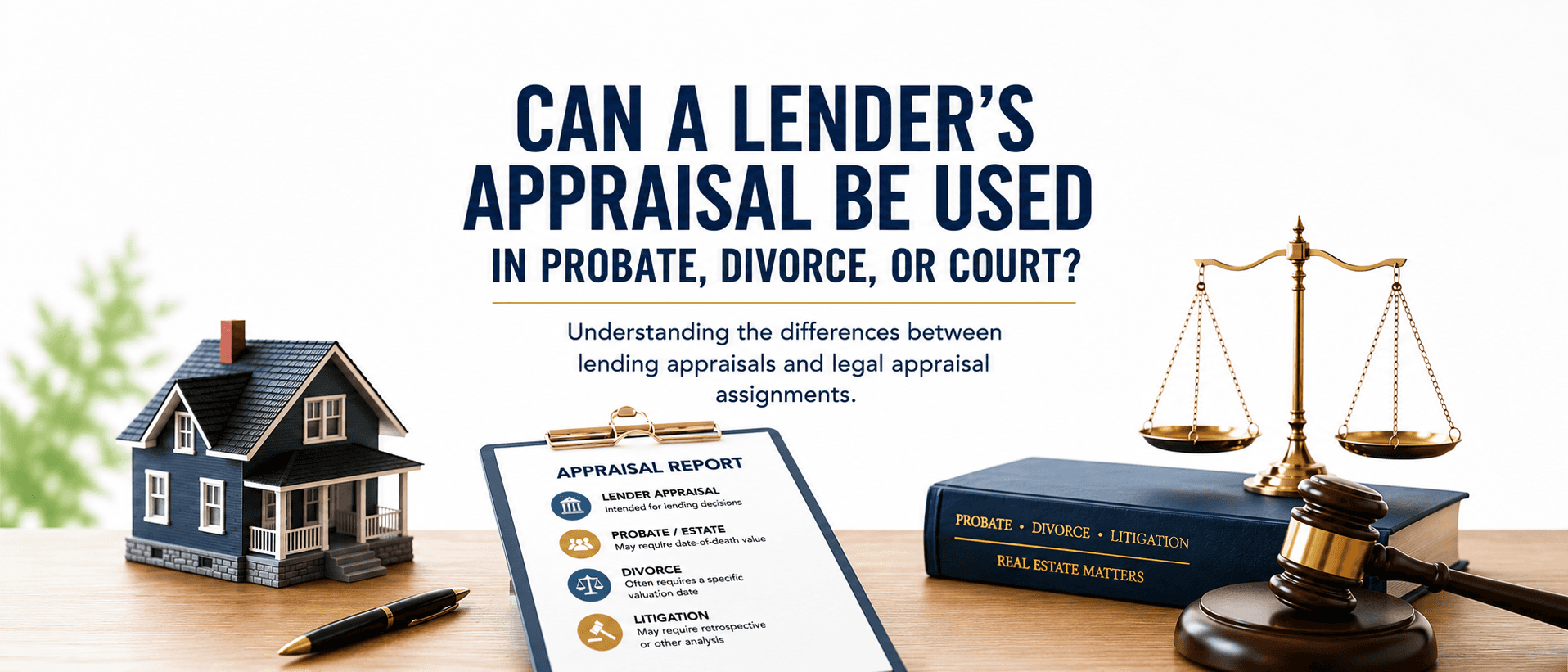
✓ Not a lender's appraisal. It was prepared for a different client and purpose. See Can a lender's appraisal be used in probate, divorce, or court?
Common Mistakes That Weaken an Estate Valuation
✓ Relying on a draft, a broker opinion or an online estimate
✓ Using a preparer without the credentials the assignment calls for
✓ Valuing the wrong interest (the whole property instead of a fractional share, or the reverse)
✓ Choosing comparables that don't match the property type, location or interest
✓ Assuming the court will split the difference between two weak reports
Bottom Line
The Tax Court has penalized an estate that relied on an unqualified valuation and rejected both sides' appraisals when the data didn't fit. In both cases, the outcome turned on the quality of the valuation, not the law.
The fix is simple to describe: the right appraiser, the right effective date, the right interest, the right comparables, and a report built to be explained in court.
This post is general information about appraisal practice and published court decisions, not legal advice. Consult counsel about how these rules apply to a specific matter.
Need an Estate Appraisal That Will Hold Up?
If you're handling an estate or probate matter and need a date-of-death or retrospective appraisal, we can help you get the effective date and scope right from the start.
Contact Authority Appraisals →
Tell us about the property and the matter, and we'll follow up with what the assignment needs and a timeline.