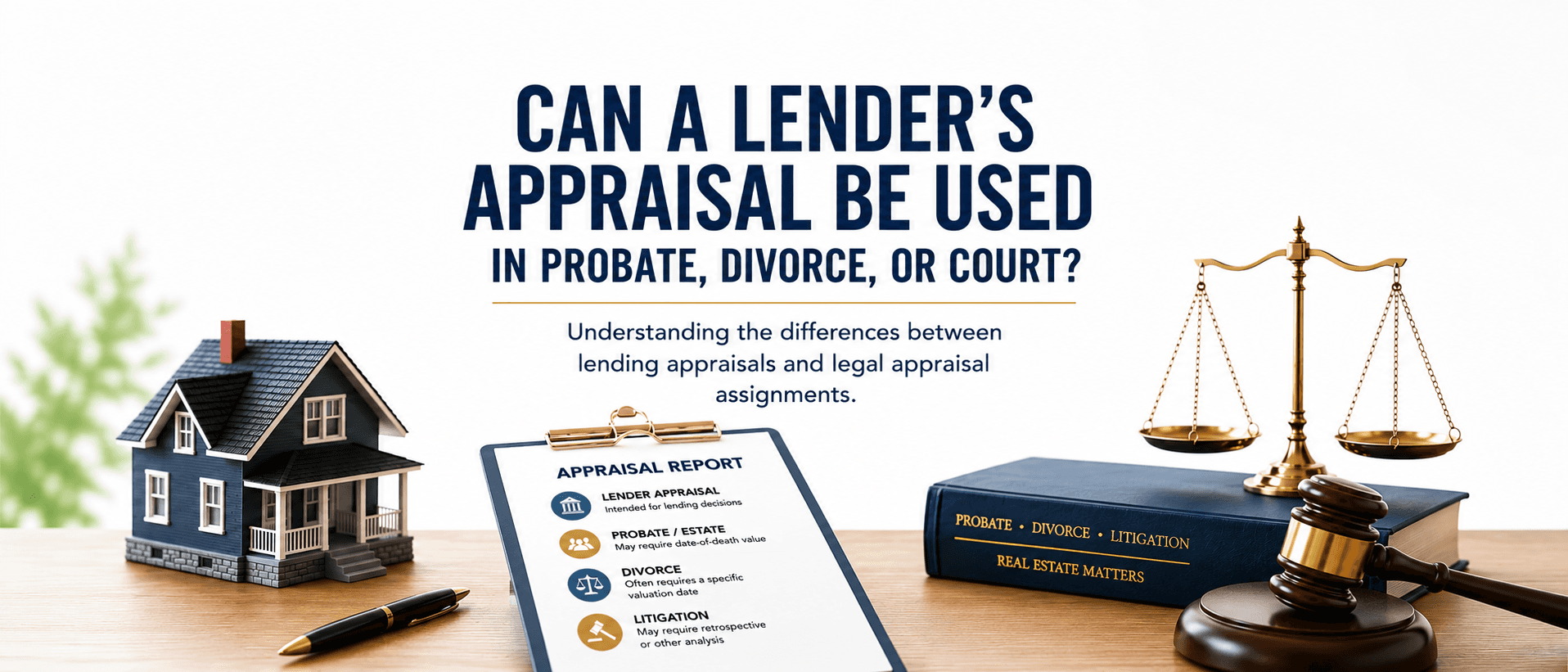
If you're buying, selling or settling a property, someone has probably handed you a number for what the home is worth. That number might come from a CMA or from an appraisal.
They sound similar, and both try to answer the same question. But they're built for different jobs, and using the wrong one can cost you time, money or a negotiation.
The Short Answer
A CMA (comparative market analysis) is a pricing tool a real estate agent uses to help you list or make an offer.
An appraisal is an independent opinion of value from a licensed or certified appraiser who has no stake in the outcome.
Key idea: A CMA helps you price a home. An appraisal helps you support a value that other people need to rely on.
CMA vs. Appraisal at a Glance
CMA | Appraisal | |
|---|---|---|
Prepared by | Real estate agent | Licensed or certified appraiser |
Purpose | Set a list price or shape an offer | Independent opinion of market value |
Independence | Agent usually represents a buyer or seller | No stake in the sale or the value |
Standards | No required method or format | Follows professional appraisal standards (USPAP) and state licensing rules |
Property visit | Sometimes, often based on listing data and photos | Typically includes an inspection of the property |
Typical cost | Often free | A professional fee |
Accepted by lenders, courts and the IRS | No | Yes |
What a CMA Does Well
A good CMA from an experienced agent is genuinely useful. Agents watch their neighborhoods closely and see how buyers are reacting right now.
A CMA usually looks at:
✓ Homes that recently sold nearby
✓ Homes currently for sale (your competition)
✓ Listings that expired or didn't sell
✓ How quickly homes are moving in the area
For everyday pricing decisions, that's often all you need.
What an Appraisal Adds
An appraiser works for no one's side and is paid the same no matter what the value turns out to be.
The appraiser researches comparable sales, adjusts for real differences between those homes and yours (size, condition, updates, lot and location), and explains the reasoning in a written report.
That independence and documentation are why lenders, attorneys, courts and tax authorities rely on appraisals, not CMAs.
Definition: Market value is the most probable price a property should bring in a competitive, open market, with a typical buyer and seller each acting knowledgeably and in their own interest.
A Practical Example
Say a homeowner is planning updates before selling. Here's how the numbers can play out (illustrative figures only):
Example | Amount |
|---|---|
As-Is Value | $310,000 |
Kitchen and bath updates | $45,000 |
As-Repaired Value | Not automatically $355,000 |
COST ≠ VALUE. What you spend on a project isn't the same as what it adds. Buyers pay for what the market rewards, and an appraiser measures that using real sales, not receipts.
A CMA might show what similar updated homes are listed for. An appraisal shows what the market supports, with the adjustments explained.
When Each One Fits
A CMA is usually enough when you're:
✓ Deciding on a list price with your agent
✓ Getting a ballpark before you sell
✓ Comparing a home you like against recent sales
✓ Curious how the market has moved
You'll want an appraisal for:
✓ Buying or refinancing with a loan (lenders require one)
✓ Settling an estate, where a date-of-death value is often needed for taxes and fair distribution
✓ Divorce, so both sides work from the same unbiased number
✓ Pre-listing, especially for unique or hard-to-compare homes
✓ Buying out a co-owner or a family member
✓ Disputes or legal matters, where a value may be challenged
Common Mistakes to Avoid
Treating a CMA like an appraisal. A CMA can't be used for a loan, a court case or an estate tax filing.
Assuming every upgrade adds its full cost. Some improvements add a lot of value, others very little. Location and buyer demand matter.
Waiting too long on estate or divorce work. These often need a value as of a specific date, and records are easier to gather sooner.
Shopping for a number. An appraisal is most useful when it's independent. A value that holds up beats a value you hoped for.
Before You Order Either One
✓ Know why you need a value (pricing, lending, estate, divorce, tax)
✓ Ask whether anyone else needs to rely on it, such as a lender, court or attorney
✓ Gather a list of recent updates with approximate dates
✓ Note anything unusual about the property, good or bad
✓ Confirm the date the value needs to reflect
Quick Recap
CMA: free or low cost, agent-prepared, great for pricing decisions
Appraisal: independent, standards-based, accepted by lenders, courts and the IRS
Many people use both: a CMA to plan a listing, an appraisal when the stakes are higher
The Bottom Line
A CMA is a smart, practical pricing tool. An appraisal is an independent opinion of value that holds up when it really counts.
If you're not sure which one your situation calls for, a quick conversation can point you in the right direction.
Ready to Find Out What You Need?
Not sure whether a CMA or an appraisal fits your situation? Send us a quick note through our contact form and we'll help you sort it out.
Contact Authority Appraisals →
Tell us a little about the property and why you need a value, and our team will follow up with next steps.