
Imagine you're preparing for a probate matter.
Your client says, "We already have an appraisal from when Mom refinanced the house a couple of years ago."
Or perhaps you're representing someone in a divorce, and they ask, "Can't we just use the appraisal from when we bought the house?"
At first glance, it seems like an easy way to save time and money.
Sometimes it is—but often, it's not that simple.
One of the most common questions we receive from attorneys, executors, trustees, and property owners is whether an existing lender's appraisal can be used for a legal matter. The answer depends on the circumstances and on whether that appraisal was developed for the needs of the current assignment.
Understanding those differences early can help avoid delays, reduce unnecessary costs, and ensure everyone is working from the most appropriate valuation.
Quick Answer
Can a lender's appraisal be used in probate, divorce, or court?
Sometimes—but not always.
A lender's appraisal was developed for a specific appraisal assignment. Whether it is appropriate for a legal matter depends on factors such as the intended use, intended users, effective date of the appraisal, scope of work, assignment conditions, and the needs of the current matter.
Before relying on an existing appraisal, it's worth discussing whether it is appropriate for your specific situation.
Why This Question Matters
Using an appraisal that wasn't developed for the needs of your assignment doesn't automatically mean there's a problem.
However, it can sometimes lead to:
Delays while additional valuation work is obtained
Disagreements between parties regarding value
Questions about whether the appraisal addresses the relevant valuation issue
The need for a separate appraisal assignment
A brief conversation before relying on an existing appraisal can often help avoid those situations.
Every Appraisal Is Developed for a Specific Assignment
One of the easiest ways to understand this issue is to remember that every appraisal assignment is designed to answer a particular valuation question.
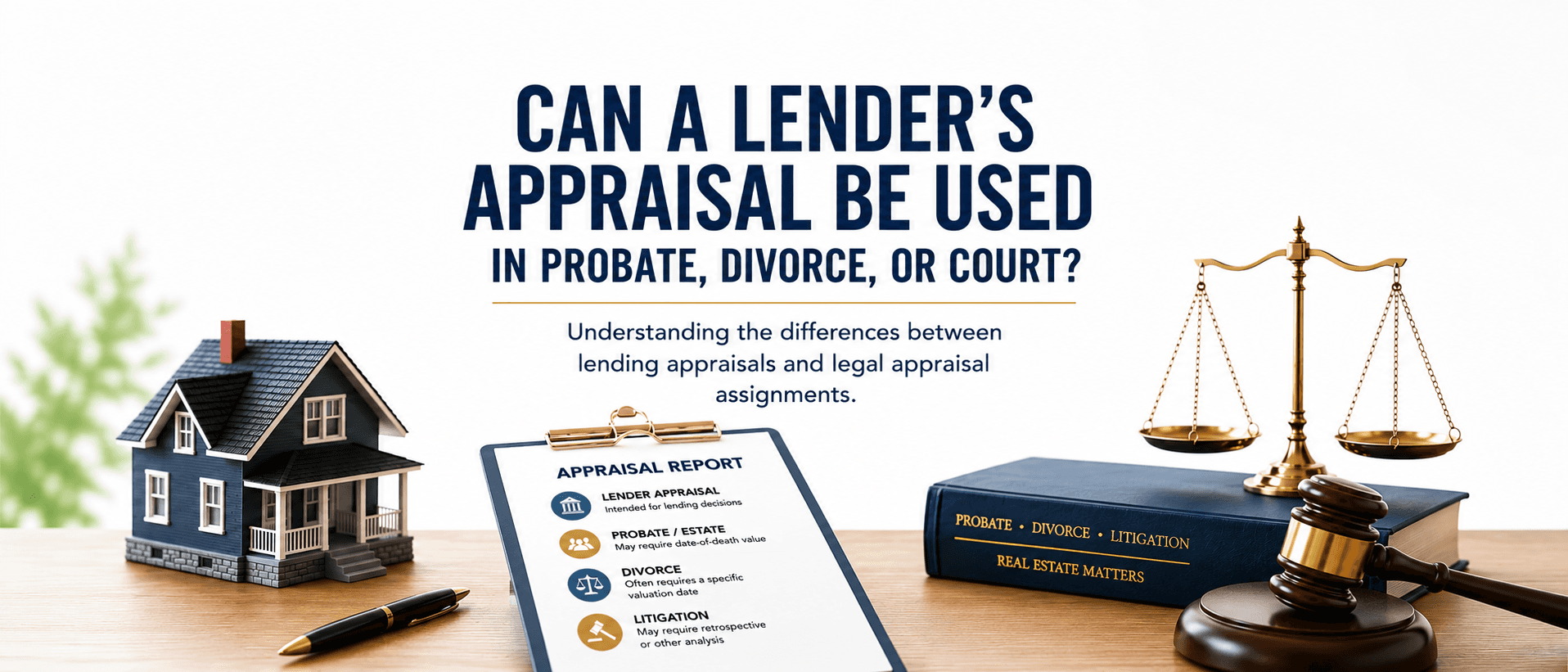
For example, a mortgage lender may need an opinion of value to assist in making a lending decision.
An estate may require an opinion of value as of the property owner's date of death.
A divorce matter may require a value as of a court-ordered or otherwise legally relevant date.
A commercial dispute may involve a retrospective value or another valuation question specific to the facts of the case.
Although these assignments all involve real estate valuation, they may differ in their intended use, effective date, scope of work, assignment conditions, or reporting requirements.
Mortgage Appraisal vs. Appraisal for a Legal Matter
Mortgage Lending Assignment | Legal Appraisal Assignment |
|---|---|
Developed for a lending-related intended use | Developed for the intended use of the legal assignment |
Often reflects current market value | May require current or retrospective value |
Assignment conditions established for the lending engagement | Assignment conditions established for the legal matter |
Scope of work designed for that assignment | Scope of work designed for the needs of that assignment |
Each assignment is developed independently based on its intended use and assignment requirements.
A Few Real-World Examples
Estate Administration
A homeowner refinanced their property in 2022 and passed away in 2025.
The refinance appraisal may provide useful background information, but if the estate requires an opinion of value as of the owner's date of death, a separate appraisal assignment may be appropriate.
Divorce
A home was purchased several years ago, and an appraisal was completed for financing.
If the court requires the property's value as of the date of separation or another legally relevant date, the earlier appraisal may not answer that valuation question.
Commercial Litigation
A commercial property was appraised during a refinance several years ago.
If a partnership dispute requires a value as of a different date or for a different purpose, the existing appraisal may not address the needs of that assignment.
Why Attorneys Often Consult an Appraiser Early
One of the most valuable steps an attorney can take is discussing the assignment before relying on an existing appraisal.
A short conversation can help determine whether:
The effective date of the existing appraisal aligns with the legal matter.
The appraisal addresses the valuation question at issue.
A new appraisal assignment may better serve the intended use.
Additional information or analysis may be needed.
That early discussion can often save time later in the process.
The Bottom Line
A lender's appraisal serves an important purpose within a mortgage transaction.
Whether that appraisal is appropriate for probate, divorce, trust administration, litigation, or another legal matter depends on the specific needs of the current assignment.
Before relying on an existing appraisal, consider asking one simple question:
Was this appraisal developed for the intended use, effective date, and assignment conditions required for this matter?
If you're unsure, we're happy to help.
At Authority Appraisals, we work with attorneys, fiduciaries, financial professionals, businesses, and property owners throughout Missouri and Illinois, providing independent residential and commercial appraisal services for estate administration, divorce, litigation, trusts, tax planning, and other legal matters.
Need a Reliable Appraisal Partner?
At Authority Appraisals, we work with Realtors, attorneys, lenders, and property owners to deliver clear, defensible valuations—on time and with the context you need to keep deals moving forward.
👉 Contact us today to discuss your next appraisal or valuation challenge.